Running or down
Know the moment a well stops, and when it came back. No more finding it on tomorrow's route.

Well monitoring for independent operators
Blackcap clips onto the motor wiring in your starter cabinet and reads every stroke your pumping unit makes. Each morning you get one list: which wells are fine, which pumped off, which went down, and what your timers are costing you.
How it works
One clamp around one motor wire, the unit on the DIN rail, the antenna outside the cabinet. Your electrician does it in one visit, with the motor locked out.
Your motor works harder on the upstroke than the downstroke, and the shape of that effort says what is happening downhole. Blackcap reads it all day and sends it over the cellular network.
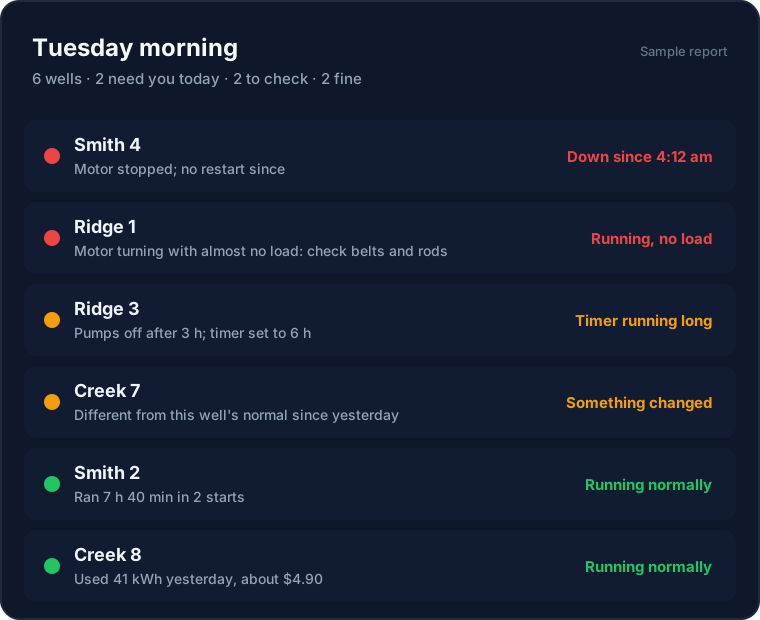
Before you leave the house: which wells are fine, which need a look, and why. The route you drive is the route that matters.
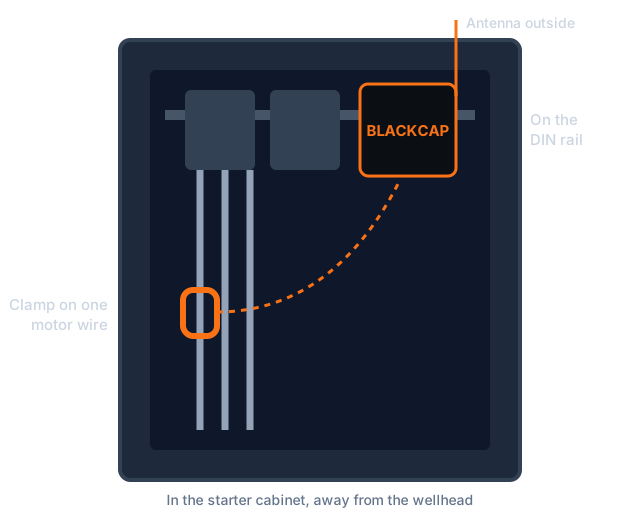
Blackcap lives in the motor starter cabinet, well away from the wellhead. No wellhead fittings, no load cell on the polished rod, nothing on the pumping unit to shake loose or get hit.
It runs from the cabinet's own power and needs no Wi-Fi, no solar panel and no battery to swap.
What you see
Know the moment a well stops, and when it came back. No more finding it on tomorrow's route.
How far into each run your well pumps off, and what the timer should be set to.
What each well used yesterday and what it cost, so the expensive ones stand out.
The motor is running but the well isn't lifting: a thrown belt or a parted rod string. Flagged right away.
Every well gets its own picture of normal. When one drifts away from it, the well goes on your list before it turns into a repair bill.
Hours run and number of starts on every well, every day, with nobody writing it down.
One list, every morning
Most stops on a pumper's route find nothing wrong. Blackcap puts the wells that need you at the top and says what changed, so the drive goes where the problems are.
of U.S. oil and gas wells produce 15 barrels of oil equivalent a day or less.
U.S. Energy Information Administration, 2024 dataof U.S. oil comes from those small wells, most of them run by small businesses.
National Stripper Well Associationsmall wells were plugged and abandoned in the ten years to 2016. Every one kept running is production kept.
Interstate Oil & Gas Compact Commission, via NSWATell us how many wells you run and where. We'll come back to you directly.
Contact us